Cyclin-dependent kinase regulatory subunit family References External links Navigation...
Protein domains
proteinscyclin-dependent protein kinasesinteractcyclinscell cycleG1G2cell divisionbindyeastfission yeastisoformmammalsisoformssubunitssymmetricalbeta-barrelhelixCKS1BCKS2
| CKS | |||||||||
|---|---|---|---|---|---|---|---|---|---|
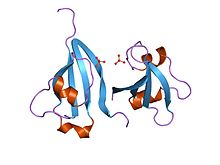 ckshs1: human cyclin dependent kinase subunit, type 1 in complex with phosphate | |||||||||
| Identifiers | |||||||||
| Symbol | CKS | ||||||||
| Pfam | PF01111 | ||||||||
| InterPro | IPR000789 | ||||||||
| PROSITE | PDOC00728 | ||||||||
| SCOPe | 1cks | ||||||||
| SUPERFAMILY | 1cks | ||||||||
| |||||||||
In molecular biology, the cyclin-dependent kinase regulatory subunit family is a family of proteins consisting of the regulatory subunits of cyclin-dependent protein kinases.
In eukaryotes, cyclin-dependent protein kinases interact with cyclins to regulate cell cycle progression, and are required for the G1 and G2 stages of cell division.[1] The proteins bind to a regulatory subunit, cyclin-dependent kinase regulatory subunit (CKS), which is essential for their function. This regulatory subunit is a small protein of 79 to 150 residues. In yeast (gene CKS1) and in fission yeast (gene suc1) a single isoform is known, while mammals have two highly related isoforms. The regulatory subunits exist as hexamers, formed by the symmetrical assembly of 3 interlocked homodimers, creating an unusual 12-stranded beta-barrel structure.[2] Through the barrel centre runs a 12A diameter tunnel, lined by 6 exposed helix pairs.[3] Six kinase units can be modelled to bind the hexameric structure, which may thus act as a hub for cyclin-dependent protein kinase multimerisation.[2][3]
This family includes the CKS1B and CKS2 genes in mammals.
References
^ Brizuela L, Draetta G, Beach D (November 1987). "p13suc1 acts in the fission yeast cell division cycle as a component of the p34cdc2 protein kinase". EMBO J. 6 (11): 3507–14. PMC 553810. PMID 3322810..mw-parser-output cite.citation{font-style:inherit}.mw-parser-output .citation q{quotes:"""""""'""'"}.mw-parser-output .citation .cs1-lock-free a{background:url("//upload.wikimedia.org/wikipedia/commons/thumb/6/65/Lock-green.svg/9px-Lock-green.svg.png")no-repeat;background-position:right .1em center}.mw-parser-output .citation .cs1-lock-limited a,.mw-parser-output .citation .cs1-lock-registration a{background:url("//upload.wikimedia.org/wikipedia/commons/thumb/d/d6/Lock-gray-alt-2.svg/9px-Lock-gray-alt-2.svg.png")no-repeat;background-position:right .1em center}.mw-parser-output .citation .cs1-lock-subscription a{background:url("//upload.wikimedia.org/wikipedia/commons/thumb/a/aa/Lock-red-alt-2.svg/9px-Lock-red-alt-2.svg.png")no-repeat;background-position:right .1em center}.mw-parser-output .cs1-subscription,.mw-parser-output .cs1-registration{color:#555}.mw-parser-output .cs1-subscription span,.mw-parser-output .cs1-registration span{border-bottom:1px dotted;cursor:help}.mw-parser-output .cs1-ws-icon a{background:url("//upload.wikimedia.org/wikipedia/commons/thumb/4/4c/Wikisource-logo.svg/12px-Wikisource-logo.svg.png")no-repeat;background-position:right .1em center}.mw-parser-output code.cs1-code{color:inherit;background:inherit;border:inherit;padding:inherit}.mw-parser-output .cs1-hidden-error{display:none;font-size:100%}.mw-parser-output .cs1-visible-error{font-size:100%}.mw-parser-output .cs1-maint{display:none;color:#33aa33;margin-left:0.3em}.mw-parser-output .cs1-subscription,.mw-parser-output .cs1-registration,.mw-parser-output .cs1-format{font-size:95%}.mw-parser-output .cs1-kern-left,.mw-parser-output .cs1-kern-wl-left{padding-left:0.2em}.mw-parser-output .cs1-kern-right,.mw-parser-output .cs1-kern-wl-right{padding-right:0.2em}
^ ab Parge HE, Arvai AS, Murtari DJ, Reed SI, Tainer JA (October 1993). "Human CksHs2 atomic structure: a role for its hexameric assembly in cell cycle control". Science. 262 (5132): 387–95. doi:10.1126/science.8211159. PMID 8211159.
^ ab Tang Y, Reed SI (May 1993). "The Cdk-associated protein Cks1 functions both in G1 and G2 in Saccharomyces cerevisiae". Genes Dev. 7 (5): 822–32. doi:10.1101/gad.7.5.822. PMID 8491379.
External links
Eukaryotic Linear Motif resource motif class DOC_CKS1_1


